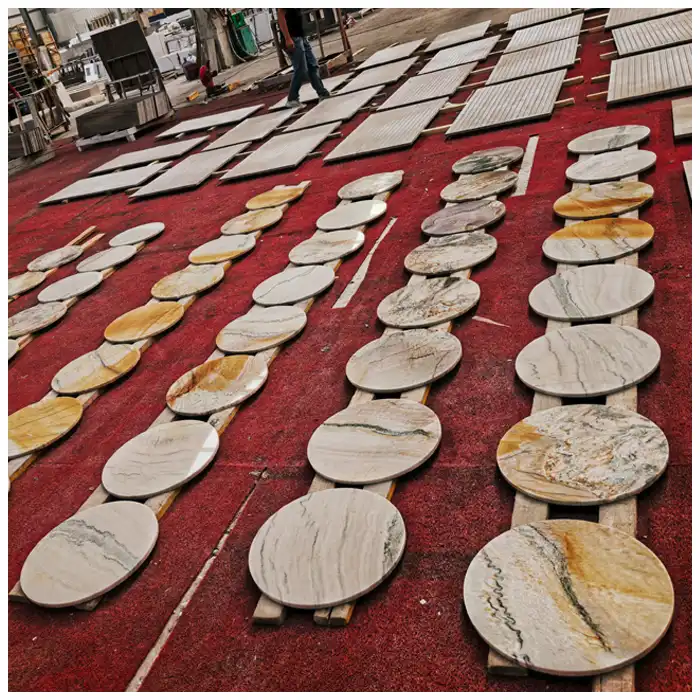
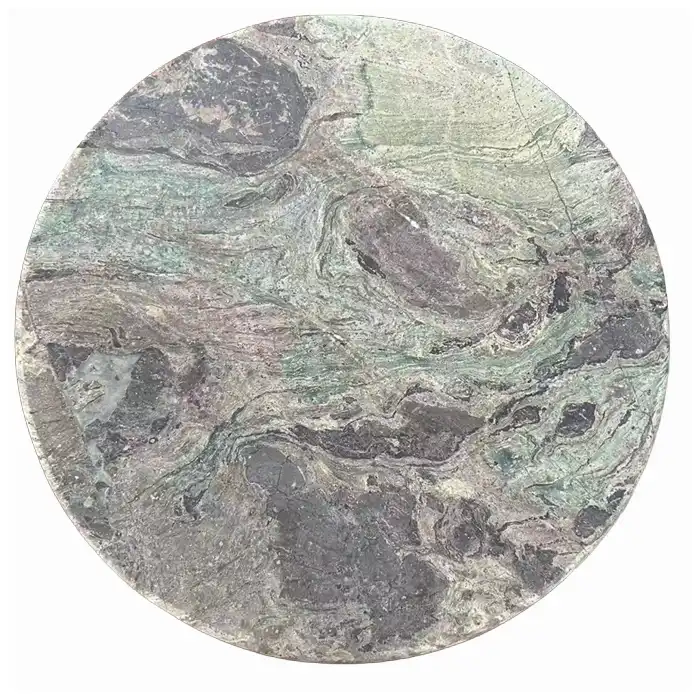
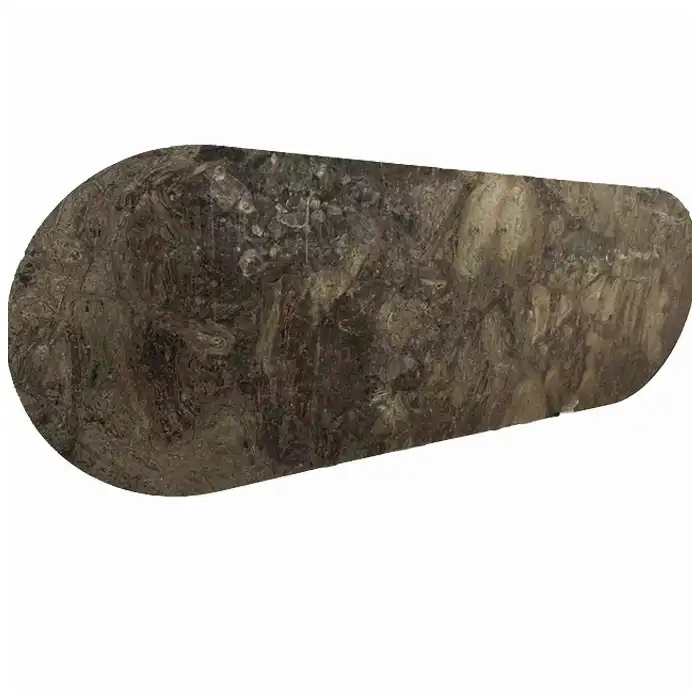
Exotic Quartzite Slab Thickness for Walls, Islands, and Stone Furniture
I remember laying my hand on the sawn edge of a pale blue quartzite while the afternoon light passed through a narrow crystalline band. The face looked deep and almost liquid. The edge felt unexpectedly lean. Beside it, a mitered sample looked twice as heavy, although both pieces came from the same slab.
That contrast is where exotic quartzite slab thickness becomes a design question rather than a catalogue number. A thick-looking apron may be a built-up edge. A slim wall panel may rely on a tested fixing system. A dining top may need a broad base even when its polished edge appears substantial. None of those conditions can be read from the face alone.
My first answer is simple: begin with the selected slabs and the finished geometry. Then ask the fabricator, installer, designer, and engineer to define what carries the load. The thickness follows that decision. It does not replace it.
What Exotic Quartzite Slab Thickness Actually Describes
Natural quartzite is a metamorphic rock formed when quartz-rich sandstone changes under heat and pressure. The interlocking quartz crystals help explain its hardness, but the general geology described in quartzite does not establish the capacity of one finished piece. Mineral seams, fissures, resin, backing, openings, edge work, support, and handling remain specific to the slab and application.
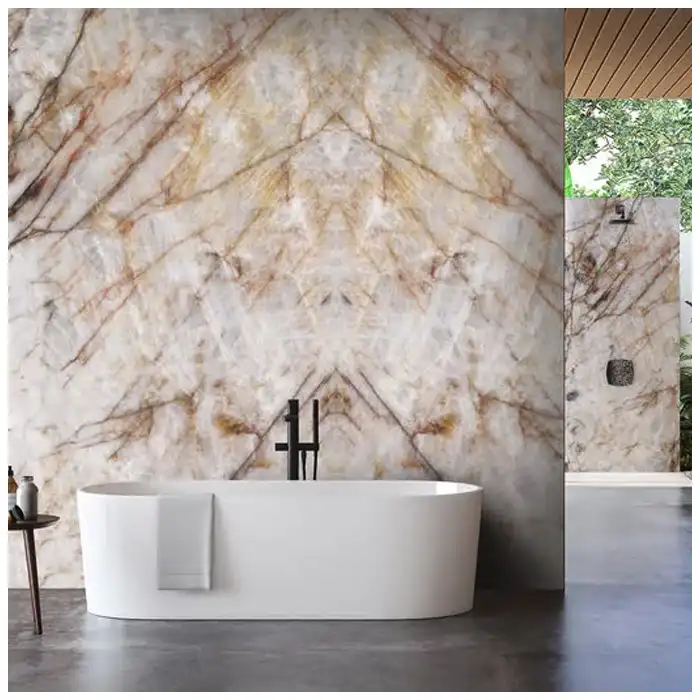
Nominal thickness is a starting description
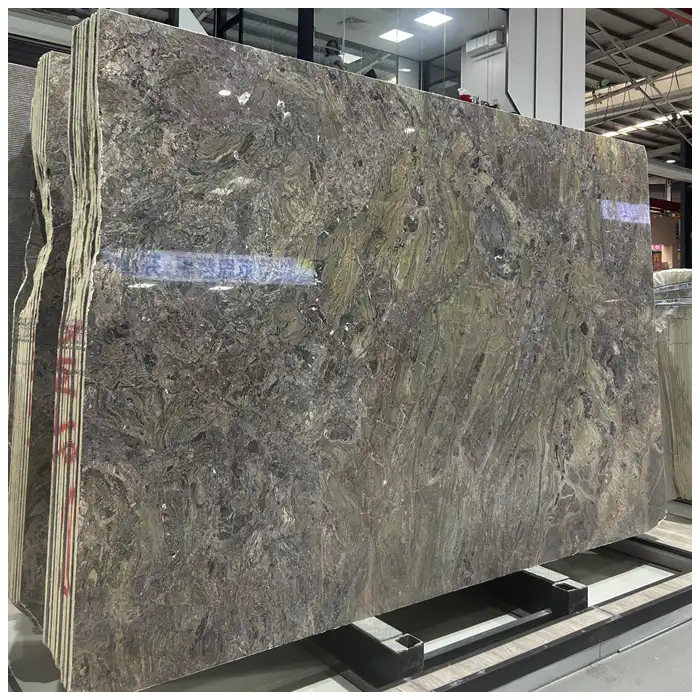
Slabs may be traded under familiar nominal categories, yet the finished material can vary after sawing, calibration, grinding, and polishing. I want measurements across the usable face, not one reading at the cleanest corner. The record should state whether the dimension refers to the raw slab, calibrated slab, or completed piece.
A calibrated Champagne Quartzite slab may carry a quiet, even edge, while a more mineral-rich face asks the fabricator to map fragile transitions before reducing thickness. The veins will tell you where the stone changes, but calipers and the cut map tell you how that change enters production.
Thickness does not cancel span
A larger section may increase stiffness and weight at the same time. It can also create greater handling stress around sink openings, cooktop cutouts, corners, and narrow bridges. Support spacing, substrate flatness, cabinet rails, wall anchors, and base footprint still control how the finished piece behaves.
For that reason, exotic quartzite slab thickness belongs beside the panel dimensions and support drawing. If a quotation lists thickness without the finished size or openings, it leaves out the geometry that gives the number meaning.
| Permohonan | Primary thickness question | Hidden control | Evidence before release |
|---|---|---|---|
| Interior wall panel | Can weight and edge condition suit the fixing design? | Substrate, anchors, kerfs, backing, joints | Panel schedule and fixing detail |
| Kitchen island | How do spans and cutouts affect remaining bridges? | Cabinet rails, steel, brackets, appliance gaps | Support plan with opening dimensions |
| Meja makan | Can the base support the top and limit cantilever? | Base footprint, frame, attachment, movement | Top and base drawings together |
| Built-up edge | Is the visual depth full section or a mitered return? | Bond line, return depth, internal support | Section detail and finished sample |
| Translucent feature | How does section alter light transmission? | Backing, adhesive, light distance, hotspots | Full-scale light mock-up |
Walls, Islands, and Furniture Ask Different Questions
Wall panels turn section into weight
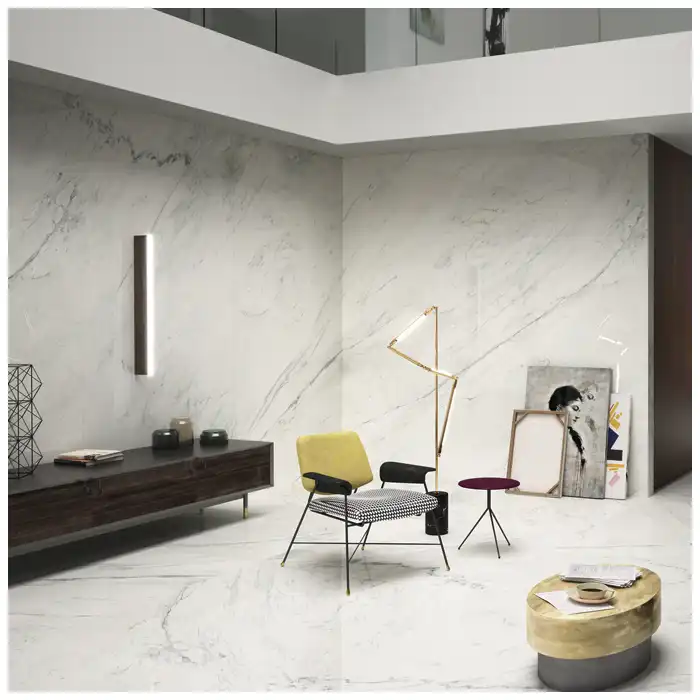
A wall sees the slab vertically. The fixing system, substrate, joint layout, panel size, anchor position, and construction movement matter as much as the stone section. Reducing weight can help handling, but a thinner panel may need backing or a different fixing concept. Those choices require competent project design, not a rule copied from a countertop.
The darker lines inside Avocado Quartzite can form a powerful vertical composition. Under grazing light, every plane change at a joint becomes visible. I therefore pair the face layout with the panel section and fixing detail before approving the bookmatch.
For wall work, quartzite wall panel thickness also affects returns around reveals, doors, niches, and outside corners. A return may expose backing or require a miter. The drawing should show how the visible edge closes, because a face-only elevation cannot answer that question.
Islands lose material around openings
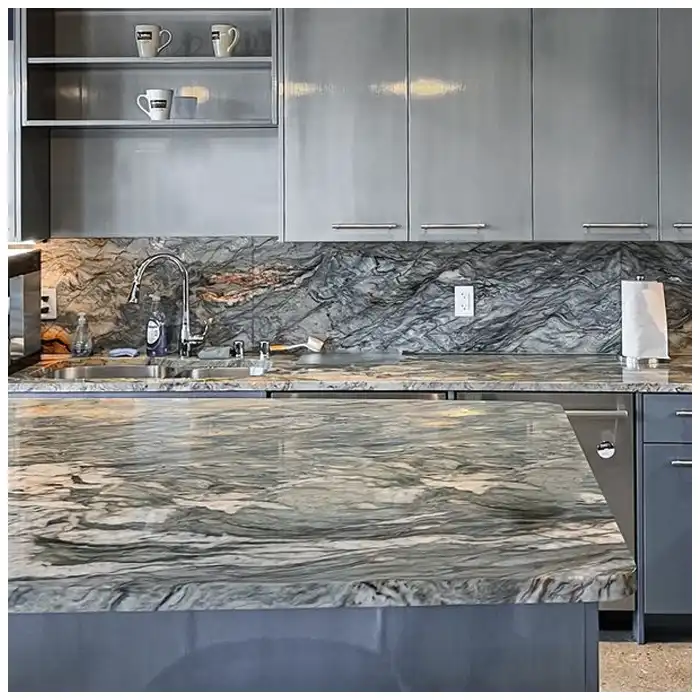
Sink and cooktop cutouts remove part of the section and create narrow rails. Transport braces, cabinet support, site access, seam location, and installation sequence can become more important than adding visual depth to the edge. A long overhang needs its own support decision.
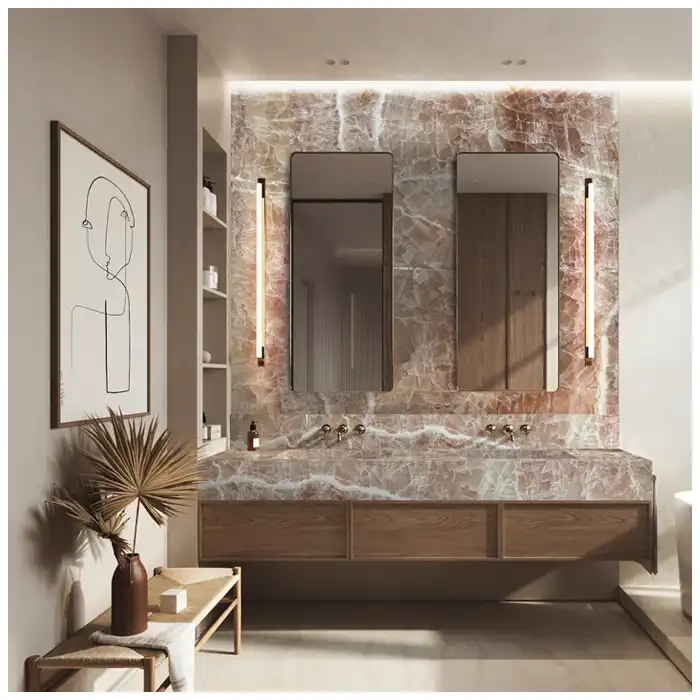
When I study exotic quartzite slab thickness for an island, I mark every opening and remaining bridge on the slab photograph. A dramatic vein crossing a narrow strip may deserve a changed cut, even if the stone around it is sound. True luxury is something you never get tired of looking at, but the composition must survive fabrication first.
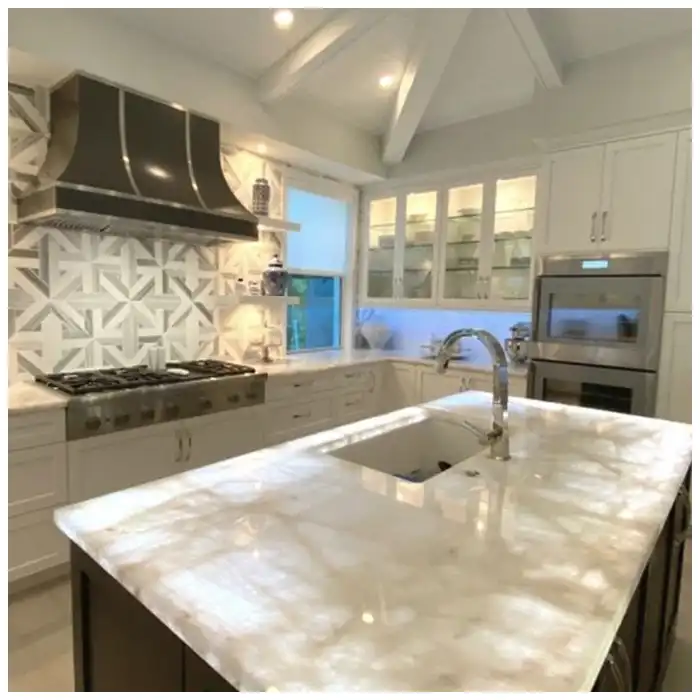
A translucent zone in Cristallo Blue Quartzite can glow near a window or pendant. That visual reward may also reveal adhesive, reinforcement, or support shadows. The section, backing, and lighting test should be decided together rather than after the top reaches site.
Furniture puts support in the center of the room
A table exposes its edge, underside, base connection, and cantilever. The stone may be touched from every side. A wide base reduces unsupported reach, while a narrow sculptural pedestal can demand an internal frame or a smaller top. Chairs and knees need clearance, so support cannot simply expand without limit.
Stone table top thickness must therefore be read with length, width, corner radius, edge form, base footprint, attachment, and intended movement. A coffee table experiences different impacts from a dining table. A console beside a wall has different tipping and support conditions from a freestanding oval top.
I place the top drawing over the selected slab face. This stone has been waiting for millions of years, and a table asks it to become an object seen from above, beside, and below. The mineral composition should remain coherent across those views.
A Mitered Quartzite Edge Is Visual Depth, Not Structural Proof
A mitered return can make a slim slab look monolithic. The saw cuts two meeting edges, the fabricator bonds them, and the vein may continue around the corner. The result can be elegant. It does not mean the whole top has the same section as the visible apron.
For exotic quartzite slab thickness, I separate three dimensions: the actual main slab, the visible finished edge, and the depth of the return. The section drawing should also identify reinforcement, substrate, adhesive, joint position, and where the return stops around openings or corners.
A bold Cosmopolitan Quartzite slab can carry a vein over a built-up edge beautifully. Yet a mismatched offcut can make that edge look pasted on. Full-face selection and offcut allocation matter because a miter transforms the edge into another visible design surface.
Lamination changes color at the joint
Resin, adhesive, polish, and mineral density can alter the line where pieces meet. Light-colored quartzite may reveal a dark bond line. Translucent material may expose the shadow of a return. I ask for a finished corner sample from representative stone before quantity work.
The edge profile removes material
A bevel, radius, chamfer, or carved detail changes the remaining section near the perimeter. Tight profiles can chip during handling if the mineral transition is poorly placed. The approved edge belongs on the first-piece record, not only in a reference photograph.
The Hard-Won Lesson: A deep apron can hide a thin decision
A design drawing labels a 60 mm island edge, so the room team assumes the top carries that full section across its width. The fabrication drawing actually uses a thinner main slab with a mitered return. A long opening and overhang remain supported according to the main slab, not the visible apron. The edge looks heavy while the hidden geometry has never changed.
The Lesson: Dimension the real slab, visible edge, return, openings, and support on the same section drawing.
What the Drawing Must Show before Cutting
The drawing for exotic quartzite slab thickness should state the finished dimensions and the method used to achieve them. I want actual slab measurements, permitted project tolerance, calibration, backing, build-ups, edge profiles, cutouts, seams, support locations, fixing zones, and visible returns on one controlled set.
Measure the selected slabs
Record several locations across each candidate face. Keep those readings with the slab IDs. If the project mixes lots or blocks, do not assume identical calibration. Thickness variation can affect joint alignment, adhesive bed, edge matching, and finished plane.
Overlay the cut map
The veins will tell you where the composition wants to move. The overlay then reveals where mineral transitions meet holes, narrow bridges, corners, anchor zones, and base edges. A slab can be visually right but badly allocated.
Coordinate the support owner
The stone supplier can provide slab and fabrication information, but the responsible designer, engineer, cabinetmaker, metalworker, installer, or fixing-system specialist must define the support within their scope. Record who approves it. Silence is not a support detail.
Plan the handling route before increasing the section
Added stone also changes the journey from fabrication bench to final position. Door width, lift capacity, turning radius, stair access, lifting points, temporary braces, and the number of controlled movements can limit the practical piece size. I ask the site team to trace that route on the drawing before a thicker specification becomes a handling problem.
The record for exotic quartzite slab thickness should therefore include the transport orientation and lifting restrictions of the finished piece. A narrow bridge around an opening may need temporary protection even when the installed support is generous. A wall panel may require a lifting frame that keeps pressure away from a luminous mineral band. These provisions do not change the beauty of the slab. They preserve it until the permanent support can take over.
Release a representative first piece
The first piece checks finished thickness, edge, bond line, plane, backing, hole finish, label, and relationship to the selected face. For a wall, include the proposed fixing detail. For furniture, place the top on the intended base or a faithful mock-up.
If a mismatch appears on site, photograph the complete piece, edge, label, support, and measuring tool first. Stop installation or further fabrication while the drawing is checked. Send the supplier the slab record, approved section, first-piece images, and site measurements so everyone compares the same condition.
Choose the Section through Evidence, Not Habit
For walls, begin with the fixing concept
Panel format, building movement, substrate, joints, anchors, and handling route establish the boundary. Stone section and backing then fit that system.
For islands, begin with openings and spans
Map the sink, cooktop, overhang, seams, appliance gaps, rails, and brackets. A visual edge decision follows the support plan instead of disguising it.
For furniture, begin with the base
Place top and base drawings together. Check footprint, attachment, cantilever, transport, assembly, floor loading, and user clearance before approving the edge.
That is why exotic quartzite slab thickness cannot be selected from one attractive table photograph. The answer belongs to the actual stone, the actual geometry, and the people responsible for carrying it.
Frequently Asked Questions
1. What exotic quartzite slab thickness is best for an island?
There is no single best number for every island. The correct section depends on the selected stone, size, openings, seams, remaining bridges, overhangs, support, edge build-up, handling, and applicable project requirements. Ask for the slab record and support drawing together.
2. Does a thicker quartzite slab always need less support?
No. A thicker slab is also heavier, and openings or long spans can still create vulnerable geometry. Cabinet rails, steel, brackets, base footprint, substrate, and installation conditions remain part of the decision.
3. Can a thin quartzite panel be used on a wall?
It may be possible within a designed wall system, but the answer depends on panel dimensions, stone condition, backing, anchors, joints, substrate, building movement, handling, and local requirements. A competent project team must approve the complete assembly.
4. Is a 60 mm edge made from a 60 mm solid slab?
Not necessarily. It may be a mitered or laminated return attached to a thinner main slab. The section drawing must distinguish actual slab thickness, visible edge depth, return construction, bond line, and hidden support.
5. What should be checked when delivered thickness differs?
Photograph measurements at several locations with the piece ID visible, stop affected work, and compare the approved slab record, fabrication drawing, tolerance, first-piece report, backing, and finish. Then decide whether adjustment, sorting, refabrication, or specialist review is required.
Quick-Reference Checklist for Quartzite Section Decisions
- Measure representative points across every selected slab.
- Draw finished dimensions, openings, seams, edges, and returns together.
- Identify backing, reinforcement, substrate, anchors, rails, or frames.
- Overlay mineral transitions on the final cut map.
- Approve one finished edge and one representative first piece.
- Record who owns the support and fixing decision.
- Recheck the section after any size, opening, base, or support change.
Final Conclusion
Exotic quartzite slab thickness earns meaning only when it is tied to actual slab measurements, final geometry, openings, backing, edges, support, handling, and light. Do not let a deep mitered apron stand in for a structural decision. I want the face, section, and support drawing on the same table before the saw starts, because MQ STONE should let the stone feel substantial without asking appearance to carry the load.
References
- Dimension Stone Design Manual, Natural Stone Institute.
- Natural Stone Countertop Installation Guidance, Natural Stone Institute.
- ASTM C616 Standard Specification for Quartz-Based Dimension Stone, ASTM International.
- ASTM C97 Standard Test Methods for Absorption and Bulk Specific Gravity of Dimension Stone, ASTM International.
- ASTM C170 Standard Test Method for Compressive Strength of Dimension Stone, ASTM International.
- ASTM C880 Standard Test Method for Flexural Strength of Dimension Stone, ASTM International.
- Dimension Stone Cladding Design Guidance, Natural Stone Institute.