New York Marble Slabs: Reading Violet Veins, Slab Sequence, and Bookmatch before Cutting
At the slab rack, I read New York marble from the aisle before moving closer. The faces look almost white at first. Violet threads then gather into wine-colored passages and dissolve into fine grey lines. The movement does not repeat, yet neighboring slabs can clearly belong together. Their sequence matters.
New York marble slabs must be selected as complete faces before bookmatching or cutting begins. The buyer needs numbered photographs, measured dimensions, mapped repairs, finish controls, and scaled overlays. A small sample can confirm touch and general tone. It cannot decide where a burgundy vein should cross a joint or whether a doorway will remove the center of the composition.
The veins will tell you where the eye wants to travel. The drawing tells us where stone must stop. Good work begins when both are visible on the same plan.
What New York Marble Slabs Reveal at Full Scale
Marble forms when carbonate-rich stone, commonly limestone or dolostone, recrystallizes under heat and pressure. Calcite or dolomite crystals interlock while accessory minerals, fractures, and mineral-bearing fluids create lines and color. That geological history helps explain why a white ground can carry violet, red-brown, grey, or fine gold movement without behaving like a printed repeat.
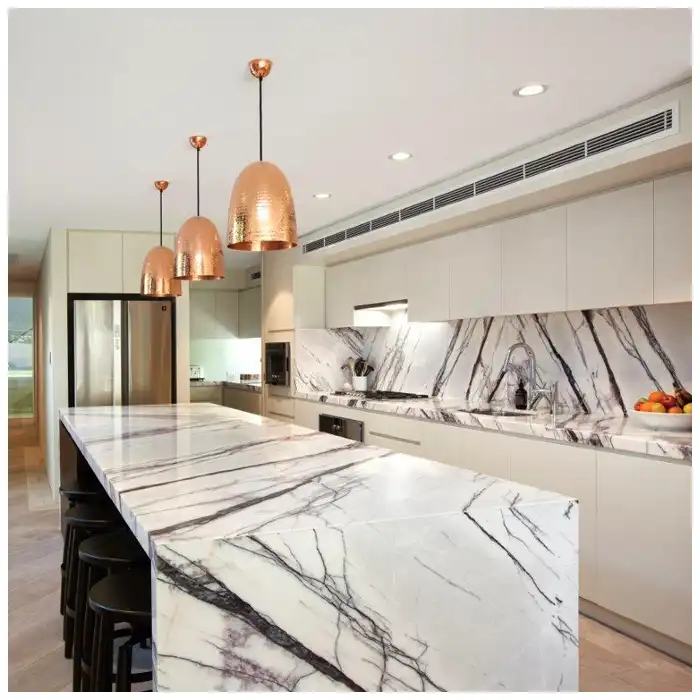
The commercial name does not guarantee one fixed palette. Current stock must speak for itself. I want square-on images of the complete face, not a dramatic crop. I also want the back, edges, resin or mesh treatment, visible repairs, natural fissures, open features, and measured usable dimensions. Beauty and condition belong in the same review, but they are not the same judgment.
The specific New York marble slab chosen for a project should carry an identity that survives cutting. Mark slab number, bundle, face orientation, finish, dimensions, and any approved treatment. If a photograph loses that identity, it becomes inspiration rather than production evidence.
Read from three distances
At ten meters, the eye reads white mass and the direction of the darkest movement. At three meters, it reads whether veins connect, collide, or leave awkward pale gaps. At arm’s length, it sees crystal texture, hairline features, filler, edge polish, and the transition between calcite-rich zones. A wall may succeed at the first two distances while a dining table must survive all three.
I use those distances to decide which faces belong in public view. A broad violet passage may hold a lobby wall together, while a quieter zone may serve a console top that carries objects. True luxury is something you never get tired of looking at, and that usually comes from proportion rather than maximum drama.
Build the Slab Sequence before Choosing a Match
Arrange numbered slab photographs in the order they came from the block when that information is reliable. Adjacent faces often share broad movement even though details shift. Then test possible sequences at the elevation’s real aspect ratio. A pair that looks balanced as two vertical slabs may feel top-heavy after a low ceiling, doorway, or cabinet line removes part of the image.
For New York marble slabs, sequence approval needs more than arrows. Show joint locations, viewing direction, floor line, ceiling line, openings, returns, lighting positions, and any furniture placed in front. A dark vein that appears central on a blank elevation may disappear behind a reception desk.
Do not assume every consecutive face belongs in one room. One may carry a sudden dense burgundy knot or a large quiet field. It can still be valuable. Allocate it where its character has room to breathe, or use it as a deliberate focal panel rather than forcing an artificial continuity.
Reserve the quiet areas
Quiet stone is not leftover stone. It can form door jambs, returns, shelving, low furniture, or the breathing space beside a strong central panel. Mark those uses before nesting. If the saw consumes all calm areas as small fillers, later corners may be assembled from fragments that compete with the main face.
A comparison with Calacatta Viola marble can help a design team discuss vein density and violet-red contrast, but approval must remain tied to the selected New York material. Similar color language does not create interchangeable slabs.
Bookmatch, Flow Match, or Let One Face Stand Alone
A bookmatch mirrors adjacent faces around a joint. It can turn two diagonal veins into a wide central gesture, yet it can also create a dark butterfly that overwhelms a narrow room. The center joint becomes part of the image. Place it against the architecture before approving the pair.
Flow matching follows movement in one direction without requiring mirror symmetry. It often suits long walls, counters, and horizontal applications where the eye travels across several pieces. The relationship depends on trimming and orientation, so show actual proposed cut boundaries rather than placing untouched slab photos side by side.
An individual face may be stronger than either system. A powder room wall, fireplace surround, table top, or framed panel can carry one complete composition. This stone has been waiting for millions of years; symmetry is not automatically more respectful than allowing a singular face to remain singular.
| Susun atur | What it emphasizes | Main risk | Approval evidence |
|---|---|---|---|
| Bookmatch | Mirror movement around one joint | Center becomes too dense or openings break the symmetry | Full elevation with centerline and actual openings |
| Flow match | Directional movement across several pieces | Trim loss interrupts the line | Numbered sequence with cut boundaries |
| Single face | One complete natural composition | Object outline removes the visual center | Scaled object overlay on the slab |
The Hard-Won Lesson: Approve the cut image, not the untouched slab
A mirrored pair can look calm while the full faces remain intact. Add a 1200 mm doorway through the quiet center, and the remaining violet movement may collect at both outer edges. Nothing about the slabs changed. The architecture changed what survived.
The Lesson: Place every opening and joint on the numbered faces before approving the match.
Place Openings, Joints, Edges, and Repairs on the Same Overlay
Cutouts are visual edits and structural interruptions. Map sinks, cooktops, outlets, switches, sconces, doors, fixtures, and mechanical access. Inspect the narrow stone that remains around them. Move an object when its opening removes the only quiet field or leaves a strong feature ending abruptly at a polished edge.
For a luxury marble wall, coordinate internal and external corners. Decide whether the movement wraps, mirrors, stops, or turns into a quieter return. A mitred corner needs enough material and a source strip that agrees with the face. A separate return can work beautifully when it is intentional; it looks careless when it is merely convenient.
Map resin, mesh, repairs, fissures, and open features without treating every mark as failure. Their acceptability depends on location, fabrication, support, finish, viewing, and the agreed standard. A filled line in a broad wall field is a different decision from the same line crossing a narrow table edge or faucet hole.
For furniture, add the base footprint, fixings, cantilever, edge profile, and underside visibility. The veins will tell you where the top feels balanced, while the support drawing protects it from loads the photograph cannot show.
Approve Finish and Fabricated Work under the Intended Light
Polish deepens the dark movement and adds reflection. Honing quiets reflection and may make the white field read softer. The right choice depends on the room, viewing angle, touch, maintenance, and actual stone. Produce finish controls from representative selected material, not an unrelated white marble.
Light from the side reveals waviness, filler, scratches, and uneven polish. Frontal diffuse light favors color comparison. Warm light can soften grey and enrich burgundy; cooler light can sharpen violet contrast. Record color temperature and direction when appearance drives approval. Otherwise the warehouse and site may be judging different images.
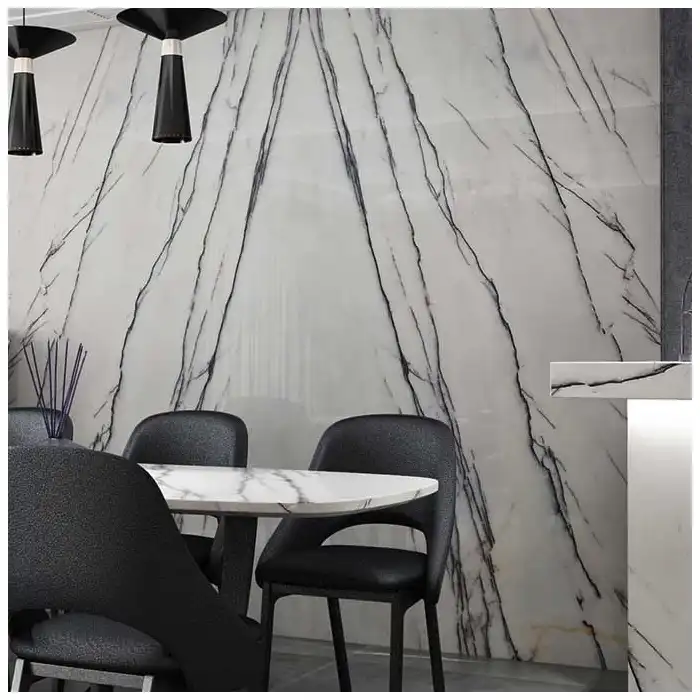
The broader Luxury Natural Stone Slabs Guide places that approval inside selection, fabrication, finish, support, inspection, and care. Manufactured surfaces can repeat a designed pattern. Natural marble asks the project team to compose with the actual faces.
Inspect fabricated pieces clean and dry. Lay connected work in sequence with joint gaps represented. Confirm identity, orientation, dimensions, edges, holes, repairs, finish, and visual relationship. Photograph the complete arrangement before protection changes what the camera can see.
If a piece loses the approved composition, photograph it, stop connected cutting or installation, and compare slab ID, overlay, orientation, drawing, and inspection records. Do not trim the piece again while the cause remains unclear. The correct response may be reorientation, relocation, approved deviation, or remake.
Translate the Slab Map into a Room Allocation
A project with several spaces needs one allocation drawing that links each numbered face to an elevation, object, or reserved spare. Begin with the areas that depend most on continuous movement. Then place smaller furniture and returns into compatible quiet zones. This order protects composition before yield pressure turns every open area into anonymous cutting stock.
When New York marble slabs serve more than one room, give each room a visual brief. One space may accept dense violet movement; another may need a pale field around artwork. Record those limits beside the slab numbers. The factory can then make a defensible substitution proposal if dimensions or condition remove the first choice.
Use a cut hierarchy
Rank pieces by visual and fabrication sensitivity. Large central panels, waterfall ends, table tops, and long polished edges usually come first. Narrow fillers, concealed returns, and small shelves come later. The hierarchy does not declare small pieces unimportant. It prevents them from consuming the only zones capable of carrying the major composition.
Show kerf, trim, squaring, excluded areas, edge strips, tests, and spares in the yield calculation. A high yield that depends on placing a repair through a narrow edge or splitting the principal vein is not efficient. It simply moves cost from material planning into fabrication risk.
Preserve provenance after the saw
Once cut, every rectangle can look detached from its source. Label the finished face, orientation, slab ID, drawing code, area, sequence, finish, and edge. Keep offcuts intended for repairs or later furniture under traceable labels too. A future replacement needs more than a matching dimension; it needs the right visual family.
The inspection set for New York marble slabs should place the fabricated sequence beside the approved overlay. Photograph full groups before close details. That order lets the architect judge composition first and fabrication second, instead of approving perfect edges on pieces that no longer belong together.
Plan the site comparison
Identify one representative control piece and the light condition for arrival review. Compare the stone clean and dry. Protect the approved photograph from automatic color changes during later editing. If the installation team uses a different camera or lamp, include a neutral reference and note the condition rather than treating images as absolute color measurement.
At handover, retain the final allocation, dry-lay, piece register, finish control, repair decisions, crate map, and spare location. This stone has been waiting for millions of years; the record only needs to survive the project. Without it, even a carefully composed room becomes difficult to repair with respect.
For later phases, repeat the approval with current stock. Do not assume that a new bundle will reproduce the original violet scale or white ground. Use the installed work as context, then select a compatible range rather than searching for an imaginary duplicate.
Before release, print the final New York marble slabs sequence at a scale large enough to read every joint. Mark the approval date and drawing revision on that same sheet.
Quick-Reference Checklist for New York Marble Selection
- Number and photograph every proposed slab as a complete clean face.
- Map usable dimensions, repairs, fissures, treatment, and finished-face direction.
- Test bookmatch, flow match, and single-face layouts at real elevation scale.
- Place openings, joints, corners, edges, lighting, and furniture on the overlays.
- Approve finish controls cut from representative selected material.
- Inspect connected fabricated pieces in sequence before protection and packing.
Frequently Asked Questions
1. What must be approved before cutting New York marble slabs?
Approve numbered full faces, measured usable dimensions, mapped conditions, sequence, finish, matching method, scaled cut overlays, joints, openings, corners, edges, repairs, and the fabricated inspection method.
2. Is bookmatching always the best layout?
No. A mirror can become too dense or lose its center around an opening. Compare bookmatch with flow matching and a single-face composition on the real elevation.
3. Can a small sample approve the color?
It can help approve general tone and finish, but it cannot represent the scale, location, or frequency of violet and burgundy movement across complete slabs.
4. How should repairs affect allocation?
Map each repair and judge it against piece geometry, edge work, support, finish, lighting, and viewing distance. Relocate or reject it when the finished position creates unacceptable risk.
5. What is the first step if the fabricated sequence differs from approval?
Photograph the complete sequence and piece labels, stop related work, then compare the numbered slabs, overlays, orientation, drawing revision, and inspection record before altering anything.
Final Conclusion
New York marble slabs succeeds when mineral scale, architecture, openings, matching, light, edges, support, finish, and piece identity remain connected. This stone has been waiting for millions of years; MQ STONE gives its largest gestures a place before the saw asks the smaller rectangles to fit.
References
- Dimension Stone Design Manual, Natural Stone Institute.
- ASTM C503 Standard Specification for Marble Dimension Stone, ASTM International.
- Standard Guide for Selection, Design, and Installation of Dimension Stone, ASTM International.
- Natural Stone Institute Technical Guidance on Stone Finishes and Repair.
- Stone Furniture Support and Installation Documents Prepared by the Responsible Project Team.
- Approved Full-Slab Images, Finish Samples, Cut Overlays, and Inspection Records for the Selected Material.
- Marmar, Wikipedia, English edition.